indiaheader

indiaheader

Sunday, January 10, 2016

A Day in the Life

We've been in Manipal, India for a little over a week now, and although our activities change from day to day, we've settled into something of a routine. Prior to the start of this program we emailed our instructor/coordinator Elissa and described our chief clinical interests, which each of us will attempt to whittle down into a concise, compelling topic for the thesis-like Scholarly Project we must complete by the end of this semester. The School of Nursing here has drafted a schedule of rotations based on our input and the degrees we are pursuing back home, such that each day, some of us report to the hospital for observational shifts on different wards, and some of us venture out into the more rural outskirts of the community to observe home-based health care and outreach programs.

Regardless of where we're headed, each weekday begins with an 8am trip to the cafeteria. Like most of the meals in India, the cafeteria options are divided into "veg" and "non-veg," the latter describing options that contain meat, fish, or eggs. Veg breakfasts cost 40 rupees (about 66 cents), and non-veg cost 50 rupees (about 83 cents).

As per usual I have no idea what virtually any of these ingredients are. The dollop of yellow at bottom right is ghee. The savory pancake and accompanying sauces are made of vegetables and mystery.
This one appeared to be a cabbage potato mixture (at left) with fried bread (top right). No matter how carb-heavy the breakfast of the day is, white toast always accompanies the offerings. The cup contains chai tea.

One day the meal was literally nothing but three types of starches: cous cous (at left), rice pilaf (top right), and toast.

If you are feeling feisty you can get an egg.

Savory cumin fritters, toast, vegetable mystery stew, chai, boiled egg, ghee.
At breakfast, we are visited by small friends.

"Don't scoot your chair too far back," Laura warned me one morning. "There's like, a kitten behind it."
After the carbo-loading is complete we assemble in front of the School of Nursing and divide ourselves based on assignment. Since Cody, Rachel and I are in the primary care/family track back at MGH, much of our time is scheduled for observation in the outpatient community setting. Manipal's nursing students are required to complete 150 days of home visits to patients in surrounding rural areas, during which time they perform a handful of basic laboratory assessments, nutritional surveys, and health education on topics tailored to the members of each family.

While waiting outside on the first clinical day, I made a discovery that filled me with glee.

Look closely...
THE RETURN OF COLLEGE BUS!
Unfortunately, College Bus is also a daily exercise in cheating death. There are no seat belts, and the folding door by the driver's seat flaps merrily in the breeze as we hurtle down the road at 70+ mph, passing pedestrians, bikers, and other vehicles on a road that never seems quite big enough to accommodate two cars side-by-side. "If we hit a bump out here and everyone goes flying, I'm going to be the first one flung headfirst out that door," I said once to Elissa, seated beside me. "Yeah," she agreed, gazing out the window. "Oh look! Rice paddies!"


On our first day in the field we visited this house, which is home to a multi-generational family of six.


Diabetes screening is one of the basic lab tests that can be performed using equipment carried and set up on-site. We watched a nursing student lay out newspaper on the front stoop of the home, add eight drops of the patient's urine sample to a test tube containing a reactive chemical, then heat the mixture over a flame. The mixture retained its original blue color, indicating a negative test. Any change in color would have indicated an elevated level of glucose in the sample -- 0.5% for green, 1.0% for yellow, 1.5% for orange, and >2% for brick red.
I wish there was a way to just make this caption say "diabeetus testing supplies" in Wilford Brimley's voice
The student told us that they can use a similar procedure to check the level of protein in the urine (a screening test for preeclampsia), but that they didn't have any field tests to evaluate urinary tract infections, STDs, or other conditions that require urinalysis.

The family invited us inside the house to share a mid-morning snack of fresh coconuts, which grow on a tree in their front yard. Vinish, one of the nursing instructors (below, at right) showed us the proper technique for drinking the juice. I happened to be wearing a bright pink lipstick, which smeared all over the coconut surface when I pressed it to my face. The family found this HILARIOUS and we all had a grand time laughing at my folly.


This tastes nothing like Vita Coco
When we'd drained the liquid from the interior, one of the men in the family deftly hacked off the top of each coconut with a small scythe, revealing the soft white flesh lining the inner cavity. They showed us how to use a piece of the shell as a spoon to scoop up the fruit as a toddler in the family looked on with envy. "The family says he is sick with a cold, so he must not eat cold foods," one of the nursing students explained to us as the mother carried the sobbing child away. "This will make him worse."
More coconuts for me
As we walked through the community, Vinish pointed out features of the landscape and built environment. Some houses have Western-style toilets, but many others have no running water. Part of the health education for this population cautions them to avoid open defecation and encourages applications to government programs that build latrines that can be shared among families.

This well provides water to the neighborhood we walked through:


"Do you have these at home?" Vinish asked. Cody and I tried to explain that our parents' houses in Rhode Island and Michigan both utilize well water, "but they don't look like this."
"No?" said Vinish.
"Well it's all underground," we clarified. "You can't see the water. There are just pipes that go directly from the well into the house."
"You must think this is very different," said Vinish.
"Yes," we admitted, staring over the edge into the water below and noting the tiny swimming creatures around the periphery.

It is said that if you stare too long into the abyss, the abyss stares back at you. In this case it's mostly tadpoles.
More pictures of the village. Note the umbrellas, which many people carry to shade themselves from the 90-degree "winter" temps:

Coconut trees!
Piles of coconut debris are a common sight throughout southern India, as the dried husks can be burned for fuel.

Rachel and Cody


Cody's last name is DeSouza, which is Portugese in origin. Portugese immigrants settled certain parts of India, so D'Souza is a common surname here. At one D'Souza house we even met a woman with the exact same name as Cody's mother.
Some of the homes are owned by much more affluent families and look like structures that could be easily transplanted into an American suburb. Elissa explained that families who are able to send relatives to work abroad in places like Dubai benefit from the extra money that these earners send home, which allows them to buy homes furnished with elaborate details like granite floors and carved wood doors.

The home of a more prosperous family outside Manipal

Inside, a nursing student prepares for a full physical examination. The allure of the crunchy newspaper proved too irresistible to the kittens, who enjoyed its satisfying crunch under their paws and had to be shooed away several times.

I've said it before and I'll say it again: when it comes to Jesus doors, go big or go home.
Not far from the more opulent houses, though, other families are living well below the poverty line. As we approached the dwelling below, the instructor told us that it housed family of nine, including a young postpartum mother with a 15-day-old baby. The grandmother had been diagnosed with anemia, so the nursing student assigned to the site had prepared a presentation identifying the foods that the woman should add to her diet to introduce more iron. This is, of course, difficult advice for a family that can barely afford basics like rice.

"See the floor you're standing on?" the instructor said. "That's polished cow dung."
The family also had a pet dog and a tiny kitten, although it was unclear whether anyone had truly wanted them or if the animals simply appeared at the home one day and had been permitted to stay. No one seemed to be paying them much attention or providing any food; as we approached, the dog was napping on the threshold and the kitten was suckling from her, perhaps fruitlessly. Just as I was admiring the cuteness of the scene, the patriarch of the family came over and whacked the kitten three times with a small tree branch. The kitten yelped and skittered away, but continued to skirt the perimeter of the scene the whole time we were there. Later, one of the young children picked the kitten up by the ear and swung him. Cody and Rachel and I watched with discomfort; as visitors here, we aren't permitted to interact very directly with patients, and even if it were appropriate to criticize this family's treatment of their own animals, we would still require an interpreter to do so.

As a self-proclaimed animal person, witnessing the widespread disinterest and even revulsion that many Indians seem to have towards animals has been one of the hardest parts of this trip for me. Everywhere we go in both city and rural environments, hundreds of docile, affectionate stray dogs roam the streets, playing and scavenging for food, eagerly setting themselves down next to anyone who tolerates it. Pedestrians and motorists mostly ignore the dogs or shoo them away, but stray cats seem to be an object of outright disgust; on several occasions we've students jumping out of the way of adorable kittens, recoiling with the same repulsed expression I might make upon seeing a rat in my basement. Coming from a culture where cats and dogs are doted upon with as much love as children, it's difficult to see so many animals who seem to crave human attention and are so consistently denied or mistreated.

Eventually the little dog was also banished - the patriarch picked her up by her two front legs and carried her out of sight behind the house. Later she and the cat reappeared and the two of them passed the time by scavenging through a nearby garbage pile for food and chasing each other around the small side yard.


When it was time for us to leave the little dog trotted over to me and put her paws on my leg. I crouched down and petted her for a few minutes while the grandfather and a few young grandchildren watched with amazement. "You don't do this, do you?" Cody asked the family, as the dog dropped to the ground and exposed her belly for me to rub, tail wagging wildly. They shook their heads and laughed heartily, amused by such an unnecessary expenditure of kindness. I felt distinctly sad as we departed, wondering how much longer both of them, and in particular the scrawny kitten, would live in this inhospitable environment. In the days since the visit I've been consoling myself with the thought that the little kids in particular might remember the bizarre novelty of a strange white girl doting on their gentle pet, and imitate that behavior in their own interactions with her. I thought about what they might say if they knew that a day before this trip, I apologized to my own dog for my upcoming absence by buying her a bag of treats and some new toys to enjoy in my time away.


File under: dogs that wouldn't survive one day in India
After our long morning away from campus, we take College Bus home...


...and consider our options for lunch. Sometimes we end up back at the cafeteria, or "mess," for a standard-issue meal that looks suspiciously similar to breakfast.

"I think what I miss the most is texture," Rachel mused sadly one day. "I just wish I had something crunchy."

More often, we order from one of the restaurants in the second floor of the cafeteria building, which is arranged like a food court and has options for Indian, Chinese, or Italian food, plus a Subway.

Possibly paneer butter masala? I don't even know at this point.
And then the rest of the afternoon is spent on a variety of tasks that might include paperwork, errands, homework, or lectures, all the while fighting off a carb coma until dinnertime.

This has been a long post. If you made it this far, congratulations. Please enjoy this unintentionally racist-sounding line of White Beauty skincare products as your reward.
Heil Pond's?
THE END.


Friday, January 8, 2016

Little Shop of Horrors

Are you interested in anatomy and physiology? Do you also want to see some absolutely terrifying medical oddities? Well have I got the place for you!
This bison penis, shockingly, is one of the less harrowing specimens you're about to see

As part of our orientation and tour of the Manipal University campus and its resources, one of our host faculty escorted us to the Manipal Museum of Anatomy and Pathology, a multi-room collection of preserved animal and human body parts. Some of the specimens were gleaned from the Kasturba Hospital here on campus, while others have come from farther afield. The museum is open to the public (a crowd of bored-looking schoolchildren was filing through while we were there) but it is particularly useful for the University's nursing and medical students as they review anatomy and disease processes.

Rachel is the Vanna White of elephant skulls

Just your daily reminder to wear sunscreen, NBD

We debated whether the owner of this gangrenous foot had merely had an amputation and might still be alive, and if he was, whether or not he ever visited his necrotic appendage on display
This massively enlarged scrotum is the result of an infection with a parasitic worm
This specimen was the only one in the museum that bore no label of any kind
Look at these various worms spilling forth from the intestine. Look until you can no longer muster the will to go on.
Undescended baby teeth in their natural habitat
If there's one thing I've learned in the medical field, it's that if you develop joint mice, you're gonna have a bad time
Conjoined twins can developed in many ways; these are thoracopagus, meaning they are fused from the upper thorax to lower belly, and share a heart
This baby had a malformed twin attached to its face
This label said "fetus with facial abnormalities"
Anencephaly occurs when a baby is born with an absent or underdeveloped brain. As one of my textbooks once stated, "it is a condition incompatible with life." Now that I've seen it in person I can see why.
Another case of anencephaly, although the label on this tank editorialized a bit with "anencephalous monster." Harsh.
The fetus at right exhibits cyclopia - the presence of only one eye
Someone whispered "this baby looks like Donald Trump," and then I couldn't unsee it.
As we were examining the fetus collection, a timid Indian woman approached three or four girls from our group, including me, and wordlessly motioned to her phone. I smiled and nodded, oblivious to the fact that she was attempting to ask permission to take a photo with me. By the time I realize what was going on it was too late; we were posing awkwardly together while her friend snapped a picture. What the woman intends to do with a slideshow of photos with strange white girls surrounded by embalmed babies, I have no idea.

The next post will be less gruesome. Promise.


Thursday, January 7, 2016

An Udupi Outing

One of the first orders of business once we got settled into our rooms was to purchase a selection of kurtas, the traditional Indian tunics that women often wear as semi-casual, semi-dressy daytime attire. The more formal wrap saris are reserved for special occasions or particular dress codes - we learned, for example, that the Manipal University administration recently decreed that all faculty wear saris to work. 

Malathi, one of our host faculty members from the Manipal School of Nursing, wears a sari daily. She also told us that the gold necklace pictured here is worn only by married women. Husbands present these to their brides on the day of the wedding and they are never removed thereafter, not even for showering.
The Manipal University nursing students wear matching uniforms consisting of black slacks and button-down dress shirts, but kurtas (for community/rural village visits) and kurtas with medical whitecoats (for hospital observation) will be sufficient wardrobe for our time here.

Laura, Andrea, Shira, and Katie, ready for a day at Kasturba Hospital
Elissa told us that the girls in previous years had purchased their kurtas at Big Bazar, a local chain department store similar to a KMart. To get there, we'd have to ride in a rickshaw to Udupi, the town adjacent to Manipal, and brave the throng of shoppers that crowd the three-story establishment. The rickshaw was a simultaneously fun and horrifying experience, but I was too paralyzed with fear to take any pictures or video. More on that another time.

When we disembarked in Udupi, the rickshaw driver deposited us in the midst of a massive parade celebrating the installation of a new priest at the local Hindu temple. Note the man giving me the stinkeye:


The old and new priests approach on a golden bird float:


The bird!

The older guy in orange, at left, is the departing temple priest. The younger one at right is his replacement.

Inside Big Bazar, a treasure trove of new and interesting products awaited us.

I think if I were to try the skin lightening lotion I would literally just disappear into nothingness
Somewhere, a copyright is narrowly avoiding infringement
Snacky brand snacks!
It turns out many of us have similar tastes in kurta fashion and ended up buying the same ones. We try to wear them on different days, but sometimes the overlap is unavoidable.

Who wore it best?
Having donned the kurtas for a few days now, we've pretty unanimously agreed that they are much breezier than we anticipated in the 90 degree heat, despite the long sleeves. The thin cotton-weave fabric breathes easily and the loose cut permits a reasonable level of comfort throughout the day. Back home in the States, our new collection might morph into sundresses or be relegated to bathing suit cover-ups, but here they are helping us to feel a little less conspicuous as outsiders.

Rachel, Andrea, and Katie in their kurtas for Kasturba Hospital orientation. At least three people purchased the green tunic that Andrea is sporting here, and I bought Katie's tunic in magenta.
What's that you say? You want some grainy, poorly-exposed dorm room mirror selfies? Well if you INSIST:


More fashion pics to come, I'm sure. For now, it's time to nap. Next time on The Wind Blows You East: a chilling visit to the anatomy museum, which featured the largest (and only) collection that I have ever seen of dead babies preserved in tanks. Stay tuned!

Wednesday, January 6, 2016

All Aboard the College Bus


Our time in Mumbai was fleeting. After one blissfully restful night at the hotel, we regrouped in the lobby and enjoyed our first sit-down Indian breakfast at the cafeteria-style buffet. Before I go further, allow me to make a confession: I don’t love Indian food. Or at least, the culinary exploration aspect of this trip was not one of the factors that drove me to apply. Back home, I never crave or suggest Indian when a bunch of friends are trying to decide what kind of takeout to order, and I certainly never attempt to make it myself. I don’t know the basic ingredients of a chutney or a curry, and I can’t really handle anything spicier than medium salsa, heatwise. I’m also easily confused by novel arrangements of familiar ingredients (is this thin sauce supposed to be ladled over the rice? Eaten as soup? Dipped with a piece of naan? Which of these colorful condiments is sweet and which is made of secret Ghost peppers waiting to annihilate my oropharyngeal cavity?). The prospect of embarrassing missteps and catastrophic spiciness miscalculations run high here. One might say that I am ill-equipped, at best, to consume nothing but Indian food day in and day out for a month.


basically me
Other hotel guests were also availing themselves of the buffet, including an Indian boy who looked to be about 8 or 9 years old. Figuring that my level of sophistication in appreciating Indian cuisine may be on par with that of a picky child, I slipped in line behind him and formed a plan: I would watch as he piled the various flatbreads, grains, and sauces onto his plate, then imitate his selection. This quickly proved impractical as the boy selected nothing but one inscrutable fried fritter after another, and I was forced to make choices at random. Luckily, everything we tried turned out to be delicious, and after sampling a dosa (a thin, crepelike pancake wrapped around a veggie filing), rice pudding, various pastries, rice and sauces, and a variety of other dishes I had no names for, we headed back to the Mumbai airport for the noon flight to Mangalore.

Pictured: Cody, and foods of unknown classification
The highlight of the day came a few hours later, after we had touched down in Mangalore and began the final leg of our journey: a 2-hour bus ride to Manipal. We made our way out of the airport and were ushered down the sidewalk by an Indian man who seemed to recognize our group and told us to “go to college bus.”

“Pardon?” someone said, as we took a turn and laid eyes upon the single greatest mode of conveyance I have ever seen before or since.

COLLEGE BUS
Needless to say, I would like to ride on College Bus for the rest of my life, to every destination.

Snack time on College Bus
College Bus may or may not have required new shocks, jostling us merrily over the winding, bumpy roads. We passed farms and semi-abandoned commerce areas; by the sides of the road, stray dogs and bulls lolled lazily in the sun or picked at the grasses growing in the dusty red soil. Just as the taxi driver had done in Mumbai, the College Bus driver honked freely whenever we approached or passed another car, and producing an especially prolonged beep as we rounded sharp curves. Visibility can be limited on these rural roads, and in city and country alike there are often no stop signs, traffic lights, or lane markings to provide order to the flow of cars, motorcycles, scooters, rickshaws, bicycles, and pedestrians that all flood the thoroughfare en masse. Rather than demonstrating frustration or anger, the frequent, unemotional beeping is akin to a heads-up; other motorists and walkers hear the horn and know a car is approaching on the right, or is intending to pass, or is about to emerge from the blind spot of a curve ahead. Amazingly, I have not witnessed any traffic accidents so far, but I worry that this may only be a matter of time.
By late afternoon the scenery had morphed from country to city, and Elissa informed us that we were now – finally –  in Manipal, home to the Manipal University School of Nursing, which would be hosting us for the month. 

One of the many stray dogs lazing about campus, unconcerned with the threat of oncoming traffic. At top right, a rickshaw.
We hadn’t been given much information about our accommodations except that they would be dormitory-style and close to campus. As we pulled up in front of the International Girls Hostel – B Block, we took in the imposing façade of our temporary home. “Wow,” someone said. “It’s… big.”
Andrea and Katie in front of International Girls Hostel - B Block
The dorm, we would come to learn, has a fairly strict set of rules for students – or as our informational packet referred to us, “inmates.” We giggled over the Do’s and Don’ts list, which instructed us not to keep or feed any pets in our rooms, not to conduct or attend parties, not to return later than 11pm curfew, not to consume any alcohol or other substances, not to keep or play televisions, not to go to any beach, not to loiter anywhere inside or outside the building, not to permit “proxy/dummy roommates in your room” (???), and not to light lamps, candles, or crackers indoors. “Take care,” the notice concluded. “Your life is precious. We value it.”

They value our lives so much that they give us allllmost 4 full pails of firefighting sand
I think I have found the problem with this student's swimming technique
Anxious to unpack for the first time in three days, we accepted our room assignments and keys from the dorm warden and began arranging our spaces. Besides being dingy and distinctly institutionalized in feel, the dorm rooms are very passable even by American university standards: air conditioning, ample storage, full private bathrooms with showers, an extra utility sink in the entry, and a standard-issue prison mattress with one pillow, a thin cotton coverlet, and about as much give as a slab of granite. Two buckets, one large and one small, had been placed next to the toilet in each bathroom – a subtle reminder that lavatories in India typically don’t provide toilet paper. Instead, spray nozzles mounted near the toilet serve as handheld bidets, or, as in the case of our rooms, a large bucket is placed near the toilet and filled with water from a spigot, while the smaller bucket is used as a scoop. Although I am eager to experience many of the cultural differences of this month abroad, bucket-bidets will not be among them.
Join me on a brief tour of Rachel's room:


Our last excursion of the night was to Dollops, a local restaurant in Manipal that Elissa promised would be simultaneously delicious, cheap, and authentic, and which had been a frequent haunt for the group last year. The menu, like most that I’ve seen here, list the names of dishes without any explanation, leaving even the more well-versed Indian food connoisseurs among us to wonder at the identity of many of the meals on offer. We selected a few familiar plates – palak paneer (usually saag or spinach paneer in the States), chicken tandoori, mushroom masala, naan, and rice – and jabbed blindly at a few others to share family-style. Our ignorance was rewarded with a smorgasbord of stews and gravies that fed the eight of us for a total cost of less than $2 per person, including tip.

From 11 o'clock clockwise: eggplant mush, chickpea mush, chicken mush, paneer mush, naan, spinach mush
And then, clutching the toilet paper we’d promptly purchased from a nearby convenience store, we trudged back to our new dorm and promptly fell into a carb-induced coma. Our next day, slated for campus orientation and a shopping trip to buy more traditional Indian clothing, promised to be a long one. Take care, the rock-hard mattress on the twin bed seemed to mock as I flopped onto it and let out an involuntary yelp of pain. Your life is precious. We value it.

Saturday, January 2, 2016

Hello tomorrow

I'm pretty sure "hello tomorrow" is the slogan of Emirates airlines, but I could be wrong, and I am entirely too tired to fact-check literally anything. The remainder of this post will therefore be a travelogue of my notes on our first 24 hours in transit.

Boston Logan International Airport
T minus 2 hours till takeoff: I arrive at Terminal C and locate the Emirates check-in counter. There are maybe 25 people ahead of me in a slow-moving line, and I feel instantly indignant. What was the point of online check-in if I still have to join this winding queue in order to obtain my boarding pass? I spot Andrea, looking similarly perturbed, in line ahead of me.
T minus 1:47 till takeoff: Other passengers appear disgruntled about the check-in process as well. To my left a middle-aged man turns to no one in particular and declares "What I want is a caramel macchiato, no sugar," revealing a fundamental misunderstanding of caramel macchiatos.
T minus 1:23 till takeoff: The line inches along. I rage-eat my sandwich.
T minus 1:08 till takeoff: It is finally my turn at the check-in counter. "How many bags are you checking?" asks the attendant.
"None," I say determinedly. "Just this carry-on."
The attendant stares dubiously at the roller bag I have stuffed to the brim with a month's worth of essentials. "Can you put it on the scale please?"
I heft the bag onto the scale and watch the number shoot to more than twice the permitted weight.
"That's not a carry-on ma'am," the attendant says.
"One checked bag," I concede.
T minus 0:49 till takeoff: "Thank you in advance for being cooperative," says the TSA agent in a patronizing tone. "A cooperative line is a moving line."
"Christ," a woman near me breathes as I remove my shoes and coat.
"Now this machine you're about to enter, this machine is state of the art. It's highly sensitive. It can detect literally anything you may have in your pockets. Your wallet, a napkin, a piece of wood -"
"Who would have that?" the same woman mutters.
" - a set of keys, a love letter from your..." the agent pauses to consider the appropriate author of such an epistle. "...wife. So please empty your pockets. The dictionary states, 'any material object that like, has matter and exists in the universe, and can be in a pocket, will be picked up on this machine.'" I feed my items through the conveyor and imagine the TSA man struggling to play the party game Dictionary, in which players compete to write the most likely-sounding dictionary descriptions of popular words.
"And don't give me some philosophical argument about how like, the old receipts in your pockets don't 'count' as objects. I've never taken a philosophy class, but - "
My items emerge from the scanner and I, mercifully, escape.

Boston to Dubai
Flight hour 0:03: Spirits are jovial. We take selfies.


Flight hour 0:05: I get a photo of us to post online and Facebook asks me the identity of the shifty-looking man in the row behind us, but hazards a guess that it is my bff Diane. Rude, Facebook. Rude.


Flight hour 0:15: I select the scientifically ludicrous film Age of Adaline from the in-flight movie touchscreen.
Flight hour 2:02: I power through a historically fanciful Kate Winslet movie in which Alan Rickman plays the French king Louis XIV. In the row ahead of me, a grown man has just completed Disney's Peter Pan and is quietly snuffling through the imaginary friend plot line from Inside Out.
Flight hour 4:13: Lunch arrives. I think briefly about taking a picture but am overcome by ravenous hunger and the window of opportunity is lost.
Flight hour 6:02: Someone notes, with what sounds like forced optimism, "we're halfway there!"
Flight hour: 6:03: The sky darkens as we move eastward. The mood sobers. This is a very long flight.
Flight hour 7:01: I watch the movie Aloha, in which Emma Stone is ostensibly part-Hawaiian and literally every character is obnoxious.
Flight hour 7:22: I pause Aloha to join the small throng of people waiting to use the lavatory. As I stand there, a conversation from years earlier surfaces in my memory. "I don't know why anyone would want to join the mile-high club," my mother once mused. "I guess it fulfills the danger thing, for some people. But those bathrooms are so small, you can barely fit one person in them anyway!"
"Yeah," I'd agreed, "and there's always someone hopping around outside waiting to have diarrhea."
"No one waits for diarrhea," my mother said. "It comes when it wants to."
Flight hour 8:33: Shira looms over the back of my seat to discuss a biography of the life of Amy Winehouse that she and Rachel have both been watching. A loose corner of my Snuggie drifts into the aisle and ensnares the wheel of a flight attendant's drink trolley.


Flight hour 8:55: Despite leaving Boston at around 11am local time, we have been flying east for hours. Early afternoon accelerates into night and now hints of dawn. The first orange streaks of sunrise appear on the horizon.
Flight hour 9:14: I drift in and out of a fitful nap.
Flight hour 9:41: Breakfast trays appear before us. On a computer screen at the front of the cabin, the local times of six world cities scroll by, but none of them make sense. Beverage service passes through the cabin and I order a coffee. When I pick up the stirrer stick, I see that it is in fact a freakishly small spoon. I nudge Rachel and Cody and gesture to the spoon, grinning wildly. "Look at this minuscule utensil! This is a spoon for DOLLS," the gesture implies. I laugh and laugh. My tenuous hold on reality weakens.


Flight hour 10:50: I am no longer within my body. I am facing myself, staring into my own glassy eyes. In medieval times, it was believed that leaving a pile of dirty rags on the ground of a house would spontaneously generate rats that infested the pile. I am a rag rat and this is my nest. I have been in seat 27H for as long as I can remember. I will die in this place.


Flight hour 11:26: Sunlight floods the cabin. A full 24 hours has not yet passed, yet here we are in tomorrow. The pilot announces our descent.
Flight hour 11:28: The flight progress screen says we have 20 minutes to landing.
Flight hour 11:38: The flight progress screen says we have 16 minutes to landing.
Flight hour 11:49: The flight progress screen says we have 19 minutes to landing. "Has the ETA been at 20 minutes for the past 20 minutes?" I ask Rachel. The possibility that we are orbiting the rim of a black hole, distorting the fabric of space-time, seems more and more probable.
Flight hour 11:54: A hollow shell of my former self arrives in Dubai.

"You were not so very different from a hobbit once. Were you? Smeagol."
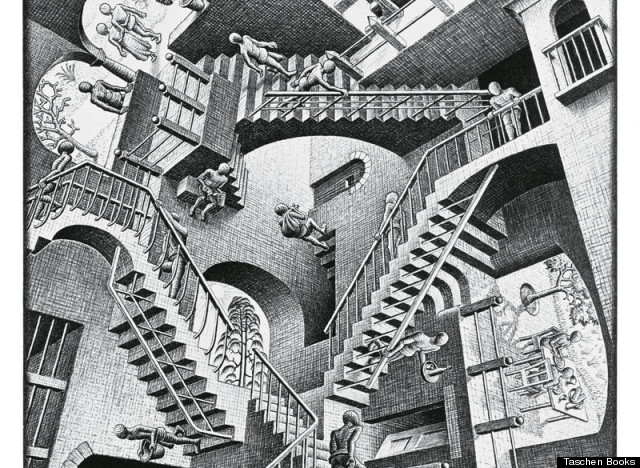
Our layover in Dubai is just barely enough time to walk through the mazelike airport in search of Gate A18, where we will board our next plane to Mumbai. The airport is like a cattle run, with huge crowds of passengers all bottlenecking at the doors that lead to the concourses. Katie attempts to warn me of hazards on the path ahead just as my foot lands in a small pile of vomit. We walk for what feels like miles on end, arriving at A18 only to find that several more staircases and security checkpoints lie between us and the plane. I remember, belatedly, that it's time to take my anti-malarial pill and fish it from the veritable pharmacy of drugs I have stashed in my purse. The med makes me dizzy and a little nauseated as we continue to trudge up and down stairs, giving the whole airport the feel of an M.C. Escher print.

Dubai International Airport
Four hundred years later, we believe we are finally at the jetway for the second leg of the flight, but are ushered onto a waiting bus instead. I become separated from the group and am pressed in by a crowd of strangers as we roll over the airport tarmac. From above, inexplicably, something drips on me. The hot Arabian sun filters through the mesh films on the bus windows and creates a pungent bouquet of bodily odors. Somewhere near the edge of the known world, the bus sputters to a stop and deposits us near the stairs to our plane.

Flight 2, hours 1-3: We sit on the runway for an hour while the pilot explains over the PA that air traffic control is doing their best to get us out of here soon. I read about 30 pages of a book and then block out all sensory input. I come to as we're making our way through Immigration.

Travel hour 5,647: As we stand in line for Customs, I see a sign that welcomes us to the region. "Karnataka, where the future is made," I read aloud.
"What? Tacos??" says Andrea, with confused hope. I shake my head and she looks deflated.

Anything to declare?
We clear Customs without issue and find our group leader Elissa standing outside the airport to collect us, as promised. She wrangles a couple of cars to take us to the hotel, and as we're waiting for them she gives us some advice. "The first rule of India is, no one will yield to pedestrians. Especially in Mumbai. They will hit you. So always make sure you stay out of the way of cars."
"Or be like, really good at rolling over car hoods," I offer.
"No," says Elissa.

The driver weaves and bobs through lanes of traffic -- vehicular, pedestrian, and pedal-powered -- that follow no laws of the road. We pass two- and three-story slums that threaten to overflow onto the busy streets below, where sidewalk merchants offer wares spread out on blankets and signs on derelict buildings advertise the services within. I spy a sign for a doctor's practice, noting that he specializes in "hair, skin, and obesity," and am excited to imagine an Indian version of Dr. Dohan until I see that the sign also promises cures via homeopathy.


Travel hour 5,648: The driver takes us to the hotel, and after a bomb-sniffing dog ensures that we are not smuggling anything but engine parts under the hood of the car, we are led inside to the Mumbai Marriott for dinner and a much needed night of sleep.

From left: Cody, Elissa, Rachel, Andrea, Katie, Shira. Not pictured: me, and Laura, who is arriving tomorrow.
We laugh at an event advertisement in the room inviting us to a concert, with the stipulations of "No unmarried couples" and "no alcohol." We decide to pass on this particular draw and retire to bed by 9pm. Hello, tomorrow. See you again soon.